


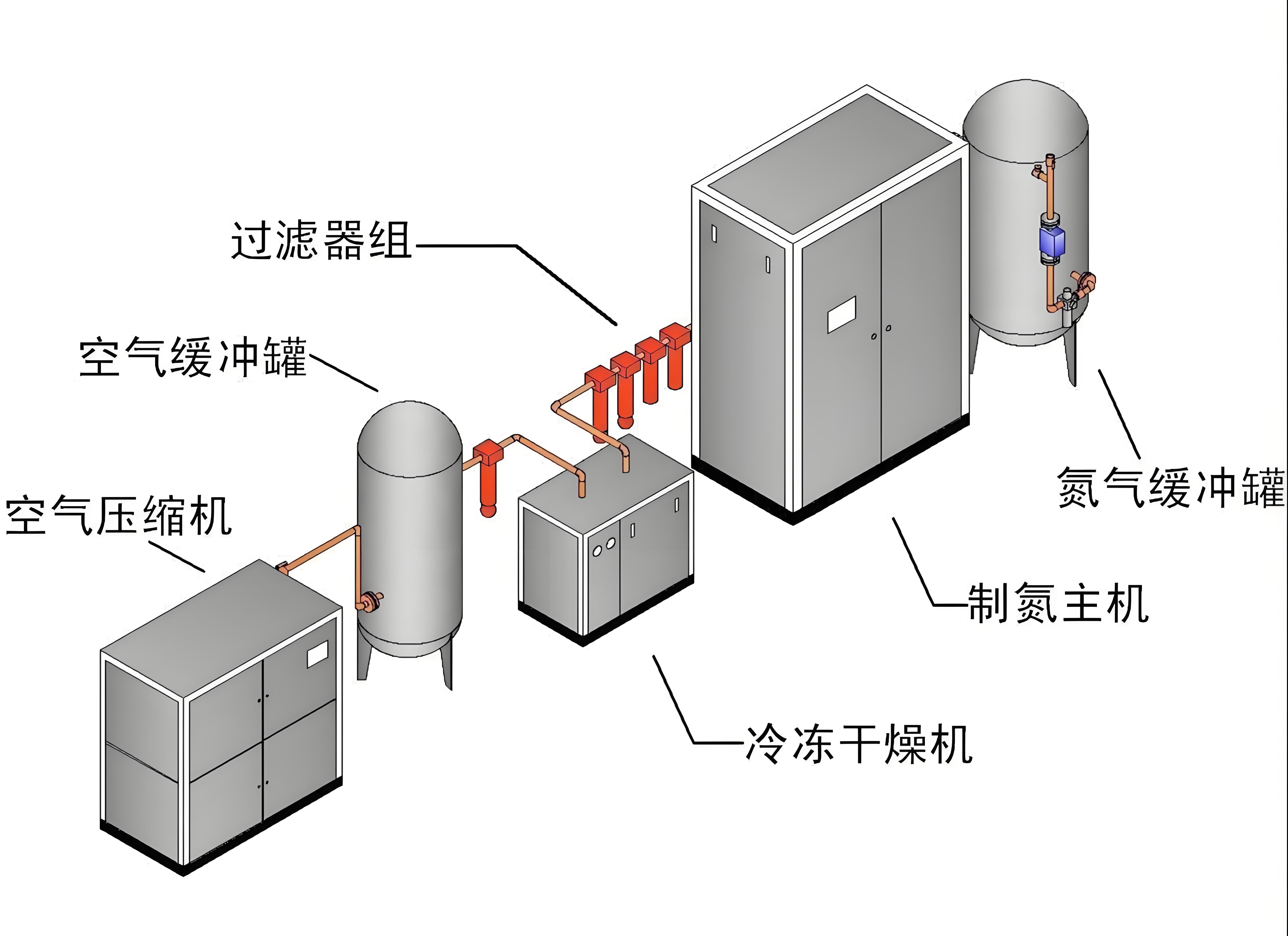
Mobile Nitrogen Separation Unit
A Mobile Nitrogen Separation Unit (MNSU) is a portable, on-demand gas production system designed to generate high-purity nitrogen from atmospheric air, optimized for mobility, rapid deployment, and adaptability to non-fixed work sites. Derived from the modular design of skid-mounted ASUs but enhanced with mobility-focused engineering, it primarily relies on Pressure Swing Adsorption (PSA) technology—ideal for scenarios requiring temporary, remote, or emergency nitrogen supply. Below is a comprehensive breakdown:
一、Core Features & Design Highlights
1. Mobility-Centric Structure
Carrier Options: Integrated into lightweight, durable carriers such as towable trailers (for road transport), containerized modules (for shipping/off-road deployment), or self-propelled chassis (for rough terrain like oilfields/mining areas). All carriers include shock-absorbing components, anti-tip supports, and weatherproof enclosures (IP54/IP65 rating) to resist dust, rain, and temperature fluctuations (-20°C to 50°C).
Compact & Lightweight: 30-40% smaller footprint than fixed skid-mounted PSA units, with weight controlled between 800-5,000 kg (depending on capacity) — enabling transport via pickup trucks or small cargo vehicles.
Quick-Deploy Design: Pre-installed piping, wiring, and integrated control panels allow on-site startup in 10-30 minutes (vs. hours for fixed units) with no civil engineering required.
二、Working Principle:Focus on PSA Technology
MNSUs predominantly use dual-tower PSA systems (cryogenic/membrane technologies are rarely adopted due to size/energy constraints) to ensure continuous nitrogen production:
Air Pretreatment: Ambient air is drawn into a pre-filter to remove dust, then passed through a coalescing filter (to eliminate oil mist) and a desiccant dryer (to reduce humidity to ≤ -40°C dew point) — critical for protecting molecular sieves in mobile environments with variable air quality.
Pressure Swing Adsorption:
Adsorption Phase: Pretreated air is compressed to 0.6-1.0 MPa and fed into Tower A, where carbon molecular sieves (CMS) selectively adsorb oxygen, carbon dioxide, and water vapor, allowing nitrogen to pass through as product gas.
Regeneration Phase: When Tower A’s sieves are saturated, the system switches to Tower B (maintaining continuous nitrogen supply). Tower A is depressurized to atmospheric pressure, releasing adsorbed gases and regenerating the sieves — no external heat required (energy-efficient for mobile use).
Nitrogen Polishing & Storage: Product nitrogen is filtered to remove residual sieve dust, then stored in a built-in buffer tank (50-200 L) to stabilize pressure, before being delivered to the end-use via a pressure-regulating valve (adjustable 0.1-0.8 MPa).
三、Key Technical Specifications
Parameter | Typical Range | Application-Focused Notes |
Nitrogen Capacity | 5-300 Nm³/h | 5-50 Nm³/h for emergency use; 50-300 Nm³/h for industrial temporary projects |
Nitrogen Purity | 95.0%-99.999% | 95%-99% for general inerting; 99.999% for precision welding/electronics |
Energy Consumption | 0.3-0.8 kWh/Nm³ (at 99.5% purity) | 10-15% higher than fixed PSA units (due to mobile compression/insulation) |
Startup Time | 10-30 minutes | Critical for emergency scenarios (e.g., pipeline leak repair) |
Air Intake Requirement | 2-4 m³ of ambient air per Nm³ of N₂ | Equipped with high-efficiency air filters for dusty environments |
Mobile Mode | Towable (≤80 km/h road speed) / Self-propelled (off-road) | Towable models fit standard vehicle hitches; self-propelled uses diesel engines |
四、Typical Application Scenarios
MNSUs excel in scenarios where fixed nitrogen supply (cylinders, fixed ASUs) is impractical or inefficient, leveraging mobility to deliver on-demand gas:
Emergency Response
Pipeline/instrument leak repair: Provides inert nitrogen to purge flammable gases (e.g., natural gas pipelines) and prevent explosions.
Disaster relief: Supplies nitrogen for temporary food storage (inert atmosphere) or medical equipment (e.g., MRI coolants) in disaster-stricken areas with broken infrastructure.
Remote Industrial Operations
Oilfield wellhead operations: Delivers nitrogen for well stimulation (fracturing fluid displacement) and wellbore inerting — no need for transporting heavy cylinders to remote oilfields.
Mining sites: Used for coal mine fire prevention (inerting coal seams) and equipment cooling, adaptable to rough terrain via off-road carriers.
Temporary Construction & Maintenance
Metal fabrication (on-site welding): Provides shielding gas for stainless steel/aluminum welding (99.99% purity) to prevent oxidation.
Bridge/tunnel construction: Inerts concrete mixing systems or seals waterproofing materials to avoid moisture damage during temporary work.
Event & Temporary Facilities
Outdoor food/beverage events: Nitrogen for beer dispensing (preserves carbonation) or snack packaging (extends shelf life).
Temporary electronics workshops: High-purity nitrogen (99.999%) for soldering or component cleaning in field service projects.
五、Advantages vs. Traditional Nitrogen Supply
Advantage | Description |
Zero Transport Risks | Eliminates hazards of nitrogen cylinder transportation (leaks, collisions) and storage space requirements. |
On-Demand Production | Adjusts nitrogen output/purity in real time (via touchscreen controls) to match on-site needs, avoiding gas waste. |
Terrain Adaptability | Customizable carriers (e.g., off-road tires, corrosion-resistant coatings) for deserts, high-altitude areas, or coastal regions. |
Cost Efficiency | 30-50% lower long-term costs than cylinder supply (no recurring cylinder rental/delivery fees) for projects lasting >3 months. |
六、Challenges & Mitigation Strategies
Capacity Limitations: Maximum output (300 Nm³/h) is lower than fixed PSA units. Mitigation: Deploy multiple MNSUs in parallel for large-scale temporary projects (e.g., offshore platform maintenance).
Outdoor Maintenance: Dust, vibration, and temperature extremes can shorten component life. Mitigation: Equip with self-cleaning filters, vibration-damping mounts, and thermal insulation; provide portable maintenance kits for on-site repairs.
Power Dependence: Requires 380V industrial power or diesel generators (for off-grid sites). Mitigation: Integrate solar panels + battery storage for low-capacity models (5-50 Nm³/h) to reduce fuel reliance.
七、Market Trends & Technological Upgrades
Miniaturization: R&D of "backpack-sized" MNSUs (5-10 Nm³/h) for emergency rescue teams and small-scale fieldwork.
Intelligent Management: Integration of IoT sensors and remote monitoring (via 4G/5G) to track nitrogen purity, sieve life, and equipment status — enabling off-site troubleshooting for remote locations.
Eco-Friendly Design: Adoption of oil-free compressors and recyclable molecular sieves to reduce carbon footprint by 20-25% compared to conventional MNSUs.
八、Installation & Operation Guidelines
On-Site Preparation:
Choose a******, well-ventilated area (≥3m clearance around the unit to avoid air intake obstruction).
Connect power (380V/50Hz) or start the built-in diesel generator; check carrier supports to prevent tipping.
Operation Steps:
Turn on the pre-filter and dryer (run for 5 minutes to pre-treat air).
Set target purity (via touchscreen) and start the PSA system; monitor the buffer tank pressure (maintain 0.6-0.8 MPa).
Routine Maintenance:
Replace pre-filter cartridges every 200 hours; regenerate desiccants every 6 months.
Inspect molecular sieves annually (replace every 3-5 years, depending on usage frequency).
Before transport: Secure all loose components, drain buffer tank condensate, and lock carrier brakes.
Name*
*Email
Phone
Message
*


